skip to main |
skip to sidebar
From just north of Shore Avenue on the East coast of the Portsmouth Peninsular, Milton Pier stretches across the expansive coastal open space of Milton Common for half a mile.The Pier is not a continuous solid structure, but a corridor of creative interventions that evoke the idea of the Milton Common as land re-claimed from the sea. The idea of water flowing in the place where we then stood brought back memories for some of houseboats and cockling in the mud and revealed a history hidden below Portsmouths largest natural grassland area.The Pier provides a vehicle for the creation of a series of sculptural interventions over the whole site. The trail, no more than three metres wide, stretches across the common, over wild grass, brambles, undulations, paths and ponds.
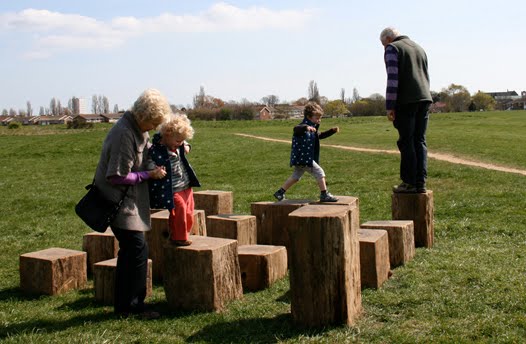
Platforms and posts made from reclaimed greenheart timber sea defences rise out of the ground, creating places to meet or for solitary contemplation, observation and exploration, a place to rest or for active physical play. The objects are connected by wild flowers that have been planted to enhance the concept of the corridor of interventions that form the pier.Notions of landscapes changing through human intervention is at the forefront of contemporary environmental study and this work is intended not only to provide a fun and active place for young people but a place for reflection and contemplation.
Based on my research I have developed a design concept that responds to the special nature of Milton Common and the way it is used by local residents.Milton Common has plenty of ‘natural play’ opportunities in its current form and my proposals aim to encourage further Exploration, Play and Discovery across the whole site through revealing some of the hidden aspects of the Common and to build stronger links between human activity, wildlife habitats and a historical and cultural understanding of the site.Through a holistic understanding of the area the designs will create new play opportunitiesthat generate further exploration across the Common. The proposed creative interventionswill encourage a deeper understanding of the site and the relationship we have with the‘natural world’.
Over the three days spent at Milton Common I spoke to a total of 44 people: those aged 6-14 years (29), 15-21 years (0), 22-59 years (6) and those over 60 years (9)The dog walkersGenerally 60 years+. Usually on their own or in couples, often stopping to chat with other dog walkers. Predominantly walking on the paths to the coast and taking a circular route back. From those who I spoke to, their main interests were the views over Langstone harbour and the ecology of the site. Some of the older residents were keen to tell me about how the land had been reclaimed and where the shoreline used to be. There was a real sense of pride and ownership over the Common and the main concerns for the place were: housing development; anti-social behaviour in the form of large groups of young people drinking, and the rubbish.The playersBetween 8-13 years. Always at least two together and in groups of up to six or seven. The young people seemed to walk or cycle to the sea front and return the same way they came. They were all very happy to participate and enjoyed making drawings to illustrate their ideas for the common. Once we moved beyond ideas for fixed play (i.e. bigger slides & swings) they came up with loads of ideas using natural and reclaimed materials including colour trails, climbing structures, humps & bumps, mazes, and a bird watching platform. The beach was a real attraction, particularly crabbing, and bike riding was very popular. There was very little understanding of what the site was like before it became the common.The familiesAll ages and using the whole site. The children used the site in the same way as ‘the players’ although would usually be younger than those out on their own. The families enjoyed doing things together and were keen that new ‘play opportunities’ should consider the parents as well as the children. It was no real surprise to learn that the weather and seasons played a huge role in how long families would stay on the Common and the activities they engaged in.The twitchersUsually male, over 50, solitary, with binoculars and camera close at hand. Often standing very still on the seaward periphery of the common, wearing an aura of ‘do not disturb’. So I didn’t.
To understand this large area of reclaimed land I have focused on a holistic approach, spending time on the Common engaged in walking, looking, listening, talking to people, picking up objects, collecting anecdotal information, drawing, writing and taking photographs. Alongside this empirical research I have collected historical maps and information about the flora and fauna with help from the PCC team.The core of my research consisted of a series of workshops aimed at learning about theCommon from the people who use it. For three days between the 28th to the 30th October I based myself on the Common with the specific intention of attracting interest from passers by and gathering information.Conversations with adults took the form of creative consultation, giving me an opportunity to learn about the history of the Common, their fears and aspirations for the site and ask how they thought young people’s experience of the Common could be improved.The informal workshops with young people were similar although I put much more emphasis on expressing the future potential of the Common through drawing.
Where did everyone go? The wind had picked up, it was a bit cold and the common was practically empty. Thankfully Sophie came on site today and kept me company. We had a good walk around the site, got some good photographs and had a chance to work on some of the ideas that were suggested on the previous days.
Another busy day on the common, I spoke to 25 people not including the commoners that came back from the day before. The young commoners liked having something different to and really wanted to show me what they liked about the place. Unfortunately this did end up in the Great Crab Massacre of Milton Common, when a group of 6 under 12’s brought back a bucket full of crabs to show me and couldn’t be bothered to take them back to the sea, so jumped on them instead. Humm, the seagulls were happy.This event aside the youngsters came up with more drawings for the site and showed an interest in helping with the production of work for the site in the New Year. When I went for a walk later in the day there was a group of about 7 children between 4 – 10 years old crabbing on the beach without adults, bikes rested up on a bench.I had some interesting talks with older commoners, particularly about the site pre-common, and the houseboats on the shoreline, which is now the new housing development. One lady described in my notes as orange jumper dog lady (she had about 5 or 6) was particularly interesting. I explained my intentions and she ranted at me how children didn’t know how to play anymore…. seemingly completely unaware that there were a group of boys on bikes riding past her, and at least 50% of the people I had spoken to that day were under 12. The activities that her children got up to on the park did sound like good fun though, building rafts on the lakes and blackberry fights. I also had a good chat with Willie Goldfinch who was building the war memorial to the north of the common and he talked to me about his nickname, working 7 days a week building the memorial and his ‘soft place to land’, being a poet.
What a great start to the first of three days on the common. Launa (9), Matthew (7) and Jemma (11) with their grandfather were the first people I spoke to whilst I was setting up. They had all been down to the harbour painting seascapes. What a wonderfully cultured bunch. During the first day I spoke to sixteen commoners (as they shall be known), of which ten were between 7 –11 and five were 50+. The older commoners were mostly concerned that my presence signalled that the site was going to be used for housing development. There was a genuine passion for this green space and the commoners were very happy to talk to me about the recent history, ecology and current use of the site. Good and bad. The re surfacing of the paths had been popular and the general feeling was that they didn’t want anything much to change. One lady was very keen to volunteer over at Tamworth Fields (an adjacent play pathfinder site) and I was encouraged that despite the large area that Milton common covers there was a real sense of pride and ownership. Two of the negative aspects that were often repeated were about it not feeling safe (particularly at night) and the litter. The young commoners that I met were nearly all 11 years old and enjoyed riding bikes, going crabbing and just hanging out on the common. They all got really involved in coming up with ideas for ‘improved play possibilities’ and made interesting contributions to the ideas map. The ideas ranges from treasure trails to tree houses, humps and bumps for bikes to places to shelter when it rains.
My first visit to the common was in mid October, to meet with Louise and Antje (PCC Landscape Architects) and Sophie (Play Pathfinder Community Projects Manager) to have a tour of the site. Before they arrived I had a short walk around to get a first impression of the Common.
There are a number of things that have stuck with me from this first visit.
•Entering the Common from the entrance opposite Moorings Way Infant School it takes quite a while to realize that this green space has its own beach and incredible vistas over Langstone Harbor.
•The evolution of this site is made apparent by the rubble and debris that breaks through the surface of the common, hinting at the history of this 'natural' environment. Looking back at the Common from the beach you can start to understand how this area was reclaimed from the sea.
•Dog walkers rule. People walking dogs make up a very high percentage of the people I saw on the park. Unlike working at the Chalk Pit in Paulsgrove my initial feeling is that due to the large size and relative openness of this site it would be much harder to identify local residents that are passionate about this site.
•Natural materials that could be used for the production of physical work seem quite scarce.
•The war memorial being constructed by 2 men to the north east of the common was a passionate and creative public response to personal concerns. There endeavours add another dimension to the park environment. (with a little help from Louise, see the memorial photo!)